- Control
Anderton Boat Lift
Located on the banks of the River Weaver in Northwich, Cheshire, the Anderton Boat Lift is one of the most significant monuments from Britain’s canal age. It is widely known as the “Cathedral of the Canals”.
Built in 1875, it was the world’s first boat lift and has since served as the prototype for many others around the world. The structure stands three storeys high and is constructed from iron. It was originally designed to speed up the movement of cargo between the River Weaver and the Trent and Mersey Canal.
A 50-foot height difference between the two waterways created a constant challenge for salt barges operating across the river and canal system.

Background
The original solution used a revolutionary hydraulic system. Huge tanks, known as “caissons”, each with watertight sealable doors, lifted boats up and down the structure. These were supported by a single central hydraulic ram. A short interconnecting tunnel was also constructed, allowing the hydraulic medium (water) to flow between the cylinders.
After a decade of operation in a heavily polluted river environment, corrosion affected the pistons and seals. As a result, the lift closed in 1906. It was later converted to an electrically driven mechanical system, which remained in operation until 1983. During routine maintenance, engineers discovered serious corrosion, and the lift was closed for a second time.
Heritage Lottery Funding
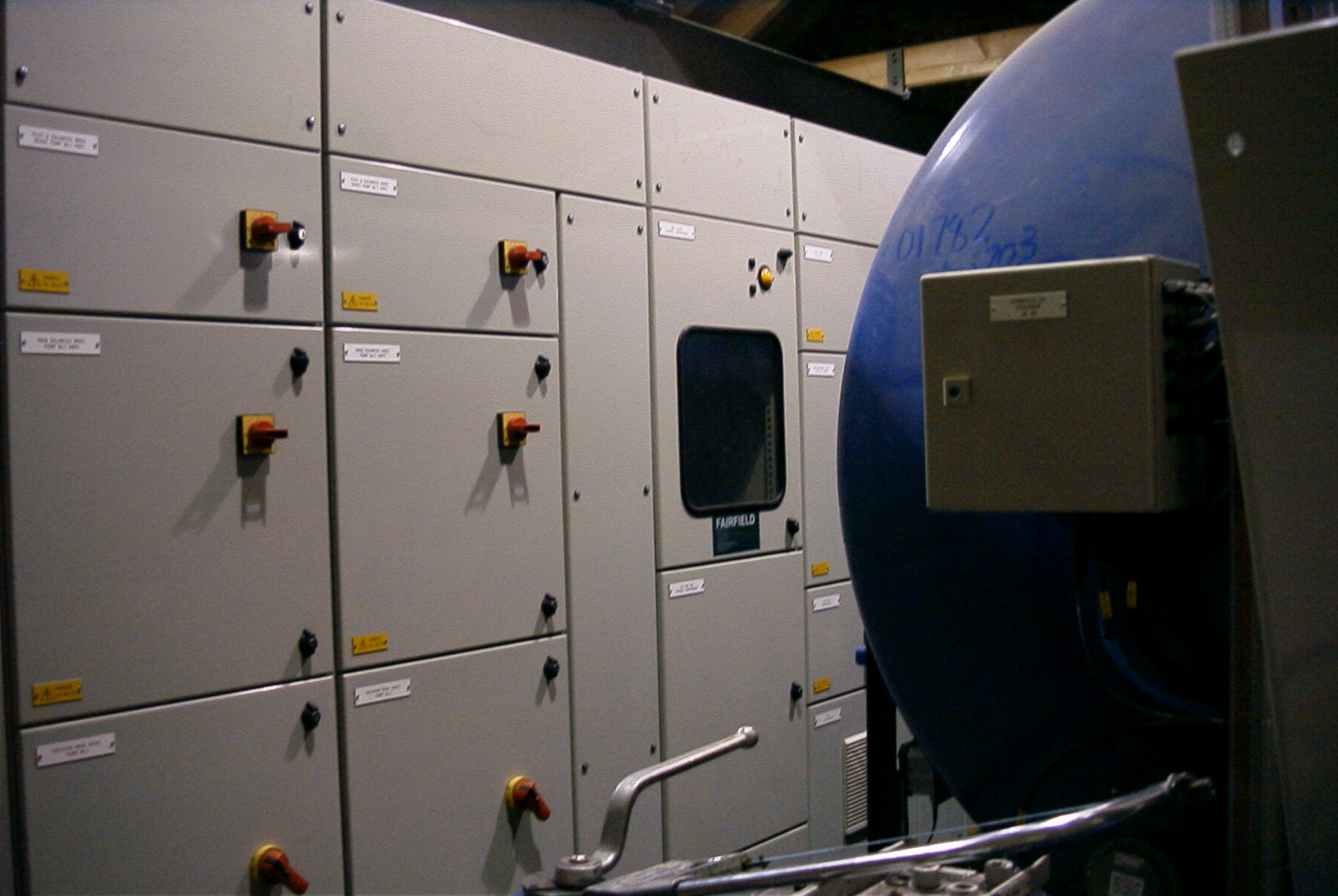
In 1998, £3.3m of Heritage Lottery Funding was secured towards the total restoration cost. The project aimed to return the lift to its original 1875 hydraulic operation. FAIRFIELDS won the contract to design and install the new electrical control system.
This work was particularly challenging because the new hydraulic system had to be integrated into the original structure. In addition, the legacy gates and wedges also had to be incorporated into a modern control system.
The Challenge
The original system operated using hydraulics, with water as the hydraulic medium. It relied on a difference in water levels between the two caissons to make the descending caisson heavier. The opposing caisson was filled from the aqueduct to a level 150 mm higher than the lower river caisson. A valve connecting the two rams was then manually operated to allow the caissons to change position.
However, when this design was replicated, issues arose in achieving the required differential pressure between the two caissons. As a result, a fully pumped system was introduced, using mineral oil as the hydraulic medium.
Balanced Mode
Two operating methods were designed into the new system. The first is “Balanced Mode”, where both caissons operate simultaneously. The second is “Isolated Mode”, where either caisson operates independently.
In Balanced Mode, both caissons contain an equal volume of water. To create movement, oil is pumped from one side to the other. This is achieved using two main 45kW pumps, providing up to 1,300 l/min of flow.
Control and acceleration of this flow are managed using an “S-curve” algorithm developed by FAIRFIELDS. In addition, smaller 18.5kW pilot pumps are used to overcome natural system leakage and maintain caisson position.
In Isolated Mode, raising a caisson requires two 90kW fixed displacement pumps. These provide the hydraulic power normally generated by the opposing caisson in Balanced Mode. This can also be described as a “virtual caisson”.
When lowering in Isolated Mode, only the main pumps are required to return oil to the reservoir.
Position Measurement and Control
Ram position is measured using a high-accuracy system known as CIMS. Each ram is finely serrated and coated with a protective CERAMAX layer. Position is calculated using an induced pulse count from the serrated ram, achieving an accuracy of 1024 counts per cm.
FAIRFIELDS developed a custom interface card to interpret the non-standard pulse signal. This interfaces with a high-speed encoder, enabling a cylinder position accuracy of 0.01 mm over 15 metres.
The Solution
The lift was successfully restored to full hydraulic operation and reopened to both boat traffic and visitors in 2002. The original 1908 structure and pulley wheels have been retained and are now on display in the visitors centre. The counterbalance weights, previously used for the caissons, were not rehung. Instead, they were repurposed to form a maze within the visitor centre grounds.
Operational control of the lift is designed to be remote from the structure itself. This allows the main lift operator to control the sequence from the Visitors Centre, using CCTV and public address systems provided by FAIRFIELDS. Local operators manage the gates, wedges and flooding valves through PanelView HMI interfaces.
Get in touch